Vacuum Gauges: Types, Ranges & Accuracy
No vacuum gauge measures every pressure. Here is which gauge works where, how accurate it is, and how to correct its reading for gases other than nitrogen.
Vacuum gauge comparison
| Gauge | Principle | Range | Gas type | Typical accuracy | Notes |
|---|---|---|---|---|---|
| Bourdon tube / dial gauge | Mechanical deformation | 1,000 – 1 mbar | Independent | ±1–3 % of full scale | Reads gauge vacuum; cheap, no power |
| Piezo-resistive | Diaphragm strain | 2,000 – 1 mbar | Independent | ±0.3 % FS | Robust, electronic output |
| Capacitance diaphragm (CDG) | Diaphragm deflection measured capacitively | 1,000 – 10⁻⁵ mbar (4 decades per head) | Independent | ±0.2 – 0.5 % of reading | Reference-grade process gauge |
| Pirani | Thermal conductivity of gas | 1,000 – 10⁻⁴ mbar | Dependent | ±15 – 30 % | Most common rough/medium gauge |
| Thermocouple / thermistor (micron gauge) | Thermal conductivity of gas | ≈10 – 10⁻³ mbar (≈7,500 – 1 micron) | Dependent | ±10 – 30 % | Typical HVAC micron gauge |
| Cold cathode (Penning / inverted magnetron) | Discharge current in magnetic field | 10⁻² – 10⁻⁹ mbar (to 10⁻¹¹ IMG) | Dependent | ±30 – 50 % | Rugged, no filament |
| Hot cathode (Bayard-Alpert) | Electron-impact ionization | 10⁻³ – 10⁻¹⁰ mbar | Dependent | ±10 – 20 % | Standard HV/UHV gauge |
| Extractor gauge | Ionization with reduced X-ray limit | 10⁻⁴ – 10⁻¹² mbar | Dependent | ±10 – 20 % | XHV measurements |
| Spinning rotor gauge | Gas friction on levitated ball | 10⁻² – 10⁻⁷ mbar | Dependent (known) | ±1 % | Transfer standard for calibration |
| Residual gas analyser (RGA) | Quadrupole mass spectrometry | 10⁻⁴ – 10⁻¹⁴ mbar (partial) | Measures each gas | Semi-quantitative | Leak hunting, contamination analysis |
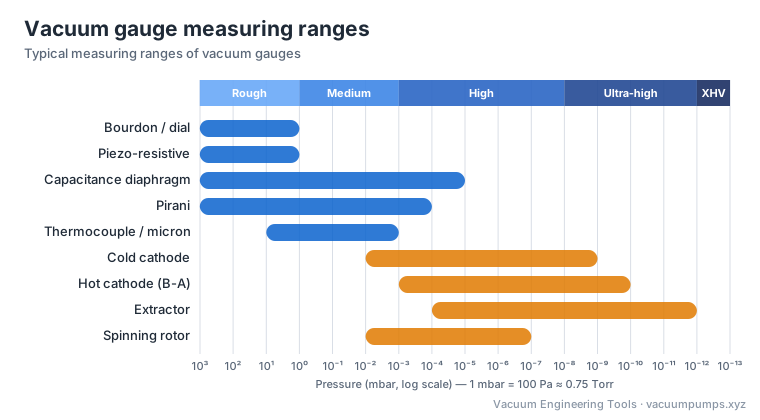
Direct vs. indirect gauges
Direct gauges (Bourdon, piezo, capacitance diaphragm) measure force per area, so the reading is the true pressure regardless of gas type. They lose resolution as the force becomes tiny, which limits them to about 10⁻⁵ mbar at best.
Indirect gauges measure a gas property that depends on molecular density — thermal conductivity (Pirani, thermocouple) or ionization (cold and hot cathode). They reach much lower pressures, but the reading depends on which gas is present and must be corrected when the gas is not nitrogen or air.
Gauge readings are only as good as their calibration. National metrology institutes such as PTB in Germany and NIST in the USA operate primary vacuum standards; accredited calibration labs trace their reference gauges back to them.
Ionization gauge gas correction factors
Relative sensitivity S (N₂ = 1.00). True pressure = indicated pressure ÷ S. Typical values; check your gauge manual.
| Gas | Relative sensitivity S | Multiply reading by |
|---|---|---|
| Nitrogen (N₂) / air | 1.00 | 1.00 |
| Oxygen (O₂) | 1.00 | 1.00 |
| Hydrogen (H₂) | 0.46 | 2.17 |
| Helium (He) | 0.18 | 5.56 |
| Neon (Ne) | 0.30 | 3.33 |
| Argon (Ar) | 1.29 | 0.78 |
| Krypton (Kr) | 1.94 | 0.52 |
| Xenon (Xe) | 2.87 | 0.35 |
| Carbon dioxide (CO₂) | 1.42 | 0.70 |
| Water vapour (H₂O) | 1.12 | 0.89 |
Choosing a gauge
- Rough vacuum, process control: piezo or capacitance diaphragm gauge.
- HVAC/R evacuation: digital micron gauge; confirm ≤500 microns and a stable decay test.
- Backing lines & general medium vacuum: Pirani.
- High vacuum chambers: combination Pirani + cold cathode or Pirani + Bayard-Alpert.
- UHV and analysis: Bayard-Alpert or extractor gauge plus an RGA.
Readings in mixed units? Convert with the vacuum unit converter.
References & further reading
- PTB Working Group 7.54. Vacuum Metrology. Physikalisch-Technische Bundesanstalt (German national metrology institute). Primary vacuum standards from 10⁻⁹ Pa to 1 kPa and gauge calibration.
- NIST. Thermodynamic Metrology Group — pressure and vacuum standards. National Institute of Standards and Technology. US primary standards for pressure, vacuum and leak rate.
- K. Jousten (ed.). Handbook of Vacuum Technology, 2nd ed.. Wiley-VCH (2016). Standard reference on gas flow, conductance, pumps and gauges.
- J. F. O’Hanlon & T. A. Gessert. A User’s Guide to Vacuum Technology, 4th ed.. Wiley (2023). Practical design of vacuum systems, pump-down and outgassing.
- CERN Accelerator School. CAS Vacuum for Particle Accelerators, Glumslöv, Sweden, 2017 — proceedings. CERN, free to read. Up-to-date lectures on materials, pumps, gauges and leak detection.
Frequently asked questions
What is the best vacuum gauge?
It depends on the range. Capacitance diaphragm gauges are the most accurate and gas-independent choice from atmosphere down to about 10⁻⁴ mbar. Pirani gauges are inexpensive and cover atmosphere to 10⁻⁴ mbar with lower accuracy. Below 10⁻³ mbar you need an ionization gauge (hot or cold cathode). Many systems use a combination gauge (Pirani + ionization or Pirani + capacitance) to cover the full range with one sensor.
Why does my Pirani gauge read wrong with helium or argon?
Pirani and thermocouple gauges measure how well a gas conducts heat, and they are calibrated for nitrogen/air. Helium conducts heat better, so the gauge over-reads; argon conducts worse, so it under-reads — and above ~1 mbar the error can exceed a factor of ten. Use the manufacturer’s gas correction curve or a gas-independent capacitance gauge.
What vacuum gauge is used for HVAC evacuation?
HVAC technicians use an electronic micron gauge (a thermistor or thermocouple thermal-conductivity gauge) to confirm the system reaches 500 microns or less and holds during a decay test. Manifold dial gauges cannot resolve this range — 500 microns is only 0.02 inHg away from full vacuum.
How do I correct an ionization gauge reading for a different gas?
Divide the indicated (N₂-equivalent) pressure by the relative sensitivity factor of the gas. For example, an indicated 1 × 10⁻⁶ mbar in pure argon (S = 1.29) is a true pressure of about 7.8 × 10⁻⁷ mbar; in helium (S = 0.18) it is about 5.6 × 10⁻⁶ mbar.
Related tools & resources
Vacuum Unit Converter
Convert between inHg, psi, kPa, mbar, Torr, microns and % vacuum — absolute and gauge.
Leak Rate & Gas Flow Converter
mbar·L/s, Pa·m³/s, Torr·L/s, atm·cc/s, sccm and slm — plus leak-tightness classes.
Vacuum Levels & Ranges
Rough, medium, high and ultra-high vacuum explained with pressure ranges and applications.
Vacuum Pump Types
Rotary vane, scroll, screw, Roots, liquid ring, turbo, diffusion, cryo and ion pumps compared.