Vacuum Line Sizing & Conductance Calculator
Find out how much pumping speed your piping costs you — and the smallest line diameter that keeps losses within limits. Covers viscous, transitional and molecular flow for air at 20 °C.
How the calculation works
Conductance of a long round tube with diameter d and length l (cm), air at 20 °C, result in L/s:
In the transitional range the two terms are added — a common engineering approximation within roughly ±15 %.
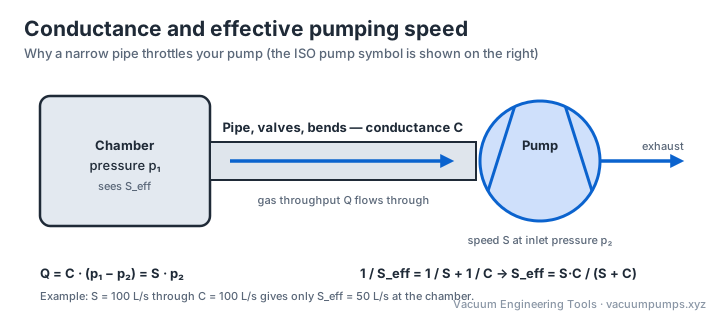
Because viscous conductance depends on the mean pressure along the line, the calculator solves the line and pump
together: the pump removes Q = S · ppump, and the same throughput must pass the line,
Q = C(p̄) · (pchamber − ppump). The effective speed at the chamber is then
Gas velocity is the actual volumetric flow divided by the pipe cross-section. The laminar formula becomes unreliable when the Reynolds number exceeds ~2,300 or the velocity approaches a sizeable fraction of the speed of sound; the calculator warns you in those cases.
Conductance of round tubes, 1 m long (air, 20 °C, L/s)
| Inner Ø (mm) | 10 mbar | 1 mbar | 0.1 mbar | 0.01 mbar | Molecular |
|---|---|---|---|---|---|
| 10 | 13.5 | 1.35 | 0.256 | 0.121 | 0.121 |
| 16 | 88.5 | 8.85 | 1.38 | 0.584 | 0.496 |
| 25 | 527 | 52.7 | 7.16 | 2.42 | 1.89 |
| 40 | 3,460 | 346 | 42.3 | 11.2 | 7.74 |
| 50 | 8,440 | 844 | 99.5 | 23.6 | 15.1 |
| 63 | 21,300 | 2,130 | 243 | 51.5 | 30.3 |
| 80 | 55,300 | 5,530 | 553 | 117 | 62 |
| 100 | 135,000 | 13,500 | 1,350 | 256 | 121 |
| 160 | 885,000 | 88,500 | 8,850 | 1,380 | 496 |
| 200 | 2.16×10⁶ | 216,000 | 21,600 | 3,130 | 968 |
Conductance scales with 1/length: a 2 m tube has half the values shown. Multiply L/s by 3.6 for m³/h, or by 2.119 for CFM.
References & further reading
- K. Jousten (ed.). Handbook of Vacuum Technology, 2nd ed.. Wiley-VCH (2016). Standard reference on gas flow, conductance, pumps and gauges.
- CERN Accelerator School. CAS Vacuum in Accelerators, Platja d’Aro, Spain, 2006 — proceedings (CERN-2007-003). CERN (2007), free to read. Lectures on gas dynamics, conductance, pumps and outgassing.
- J. F. O’Hanlon & T. A. Gessert. A User’s Guide to Vacuum Technology, 4th ed.. Wiley (2023). Practical design of vacuum systems, pump-down and outgassing.
Frequently asked questions
How do you size a vacuum line?
Choose a diameter whose conductance C is large compared with the pump speed S. The effective speed is S_eff = S·C/(S + C), so C = 9·S keeps the loss to 10 %, and C = 4·S to 20 %. Conductance rises with d⁴ in viscous flow and d³ in molecular flow, so a slightly larger pipe helps far more than a slightly shorter one.
What is vacuum conductance?
Conductance C is the ability of a pipe, valve or orifice to pass gas, defined as C = Q / (p₁ − p₂), where Q is the gas throughput. It has the same units as pumping speed (L/s or m³/h). Conductances in series add reciprocally (1/C = 1/C₁ + 1/C₂ …); in parallel they add directly.
Why does line size matter more at low pressure?
In viscous (rough vacuum) flow, conductance is proportional to the average pressure, so it drops as you pump down. In molecular flow (high vacuum) it no longer depends on pressure but is typically much smaller than in rough vacuum. A line that is fine at 100 mbar can throttle a pump badly at 0.01 mbar.
Should the vacuum line be the same size as the pump inlet?
At minimum, yes — never neck down below the pump inlet. For long runs or low pressures, go one or two sizes larger than the inlet and keep the line as short and straight as possible. Each 90° elbow adds roughly the equivalent of one to a few pipe diameters of straight length.
What is the flow regime in a vacuum pipe?
It is set by the Knudsen number Kn = λ/d (mean free path over pipe diameter). Kn < 0.01 is viscous (continuum) flow, Kn > 0.5 is molecular flow, and in between is transitional (Knudsen) flow. For air at 20 °C, λ ≈ 6.6 mm at 1 Pa (0.01 mbar).
Related tools & resources
Vacuum Unit Converter
Convert between inHg, psi, kPa, mbar, Torr, microns and % vacuum — absolute and gauge.
Pump-Down Time Calculator
Evacuation time for a chamber — or the pump size you need for a target time.
Mean Free Path & Knudsen Number
Mean free path of air, N₂, He, Ar and more, and the flow regime in your pipe.
Vacuum Pump Types
Rotary vane, scroll, screw, Roots, liquid ring, turbo, diffusion, cryo and ion pumps compared.