Boiling Point Under Vacuum Calculator
Find the temperature at which a liquid boils at a given vacuum — or the vacuum you need to boil it at a chosen temperature. Useful for vacuum distillation, rotary evaporation, vacuum drying, degassing and freeze drying.
How boiling point depends on pressure
A liquid boils when its vapor pressure equals the pressure above it. At sea level that is 101.325 kPa, so water boils at 100 °C. Pull a vacuum and the liquid only needs to reach a lower vapor pressure — and therefore a lower temperature — to boil. That is why vacuum lets you evaporate solvents gently, dry heat-sensitive products and dehydrate refrigeration systems.
For most liquids the relationship follows the Antoine equation (coefficients for hundreds of substances are listed in the NIST Chemistry WebBook):
Solving for T gives the boiling point at pressure P. For water this calculator uses the more accurate IAPWS saturation curve; below the triple point (611.7 Pa / 4.58 Torr / 0.01 °C) it switches to the sublimation curve of ice, which is what matters in freeze drying and deep HVAC evacuation.
Boiling point of water under vacuum (chart)
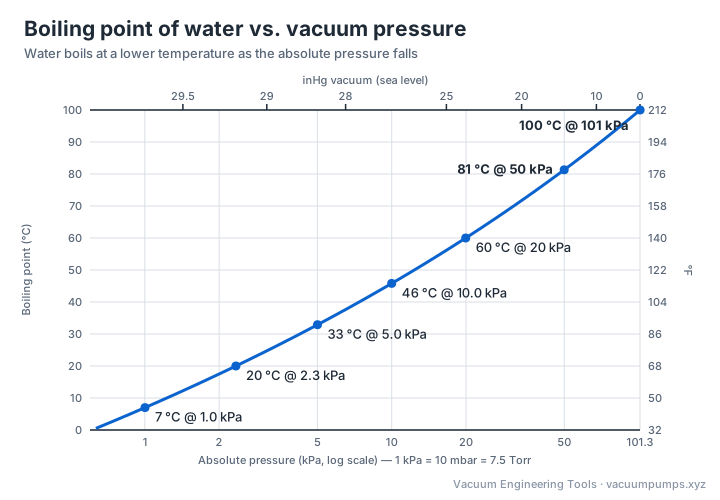
Sea-level reference (29.92 inHg). For other altitudes, use the calculator with an absolute pressure.
| inHg vacuum | kPa abs | Torr | psia | Boiling point °C | Boiling point °F |
|---|---|---|---|---|---|
| 0 | 101.33 | 760.0 | 14.70 | 100.0 | 212.0 |
| 5 | 84.39 | 633.0 | 12.24 | 94.9 | 202.9 |
| 10 | 67.46 | 506.0 | 9.78 | 89.0 | 192.1 |
| 15 | 50.53 | 379.0 | 7.33 | 81.6 | 178.8 |
| 20 | 33.60 | 252.0 | 4.87 | 71.7 | 161.1 |
| 22 | 26.82 | 201.2 | 3.89 | 66.5 | 151.8 |
| 24 | 20.05 | 150.4 | 2.91 | 60.1 | 140.2 |
| 25 | 16.67 | 125.0 | 2.42 | 56.2 | 133.1 |
| 26 | 13.28 | 99.6 | 1.93 | 51.5 | 124.6 |
| 27 | 9.89 | 74.2 | 1.43 | 45.6 | 114.1 |
| 28 | 6.51 | 48.8 | 0.94 | 37.6 | 99.8 |
| 28.5 | 4.81 | 36.1 | 0.70 | 32.2 | 90.0 |
| 29 | 3.12 | 23.4 | 0.45 | 24.7 | 76.5 |
| 29.5 | 1.43 | 10.7 | 0.21 | 12.3 | 54.1 |
| 29.7 | 0.75 | 5.6 | 0.11 | 2.8 | 37.1 |
| 29.8 | 0.41 | 3.1 | 0.06 | -4.7 | 23.5 |
| 29.9 | 0.07 | 0.5 | 0.01 | -23.7 | -10.7 |
Solvent boiling points at reduced pressure (°C)
| Pressure (mbar) | Water | Ethanol | Methanol | Isopropanol (IPA) | Acetone | n-Hexane | Toluene |
|---|---|---|---|---|---|---|---|
| 1,013.25 | 100.0 | 78.3 | 64.5 | 82.3 | 56.2 | 68.7 | 110.6 |
| 500 | 81.3 | 61.5 | 47.6 | 65.6 | 36.9 | 47.8 | 87.5 |
| 200 | 60.1 | 42.2 | 28.2 | 46.5 | 15.5 | 24.8 | 61.9 |
| 100 | 45.8 | 29.3 | 15.2 | 33.6 | 1.5 | 9.8 | 45.3 |
| 50 | 32.9 | 17.5 | 3.4 | 22.0 | -11.0 | -3.5 | 30.5 |
| 20 | 17.5 | 3.5 | -10.6 | 8.1 | -25.5 | -18.9 | 13.2 |
| 10 | 7.0 | -6.1 | -20.1 | -1.3 | -35.2 | -29.2 | 1.7 |
Values outside a liquid's Antoine validity range are extrapolated and less accurate. Also see the full water vapor pressure table.
References & further reading
- IAPWS. SR1-86(1992): Revised Supplementary Release on Saturation Properties of Ordinary Water Substance. International Association for the Properties of Water and Steam. Saturation vapour pressure equation used for liquid water.
- W. Wagner & A. Pruss. The IAPWS Formulation 1995 for the Thermodynamic Properties of Ordinary Water Substance for General and Scientific Use. J. Phys. Chem. Ref. Data 31, 387 (2002). Reference equation of state for water.
- D. M. Murphy & T. Koop. Review of the vapour pressures of ice and supercooled water for atmospheric applications. Q. J. R. Meteorol. Soc. 131, 1539 (2005). Sublimation pressure over ice below 0.01 °C.
- NIST. NIST Chemistry WebBook, SRD 69. National Institute of Standards and Technology. Antoine coefficients and phase-change data for solvents.
Frequently asked questions
What temperature does water boil in a vacuum?
It depends on how deep the vacuum is. At 25 inHg vacuum (16.7 kPa abs) water boils at about 56 °C (133 °F); at 29 inHg vacuum (3.1 kPa abs) at about 25 °C (77 °F); and at 1 kPa (7.5 Torr) at about 7 °C (45 °F). Below 611.7 Pa (4.6 Torr), the triple point, liquid water cannot exist and ice sublimes directly to vapor.
Can water boil at room temperature?
Yes. Water boils at 20 °C when the absolute pressure drops to 2.34 kPa (17.5 Torr, 23.4 mbar), which is about 29.2 inHg vacuum at sea level. Any vacuum pump that can reach below ~20 mbar will boil room-temperature water.
Why does water boil at a lower temperature under vacuum?
A liquid boils when its vapor pressure equals the surrounding pressure. Lowering the surrounding pressure means the liquid reaches that point at a lower temperature, so less heat is needed to vaporise it.
What vacuum do I need for vacuum distillation or rotary evaporation?
A common rule (the "delta-20 rule") is to set the heating bath about 20 °C above the desired vapour temperature and the condenser about 20 °C below it. Use the temperature → pressure mode of this calculator to find the vacuum where your solvent boils at the target vapour temperature, typically 30–40 °C.
How accurate is this boiling point calculator?
Water uses the IAPWS Wagner–Pruss saturation equation (liquid) and the Murphy–Koop equation (ice), accurate to well under 0.1 °C. Other liquids use published Antoine coefficients, typically within 1 °C inside the listed temperature range. Dissolved solids, mixtures and superheating are not accounted for.
Related tools & resources
Vacuum Unit Converter
Convert between inHg, psi, kPa, mbar, Torr, microns and % vacuum — absolute and gauge.
Pump-Down Time Calculator
Evacuation time for a chamber — or the pump size you need for a target time.
Vacuum Pump Types
Rotary vane, scroll, screw, Roots, liquid ring, turbo, diffusion, cryo and ion pumps compared.
Water Vapor Pressure Table
Vapor pressure of water from −40 °C to 150 °C in Pa, mbar, Torr, psi and inHg.