Vacuum Levels & Pressure Ranges
“Vacuum” covers more than 15 orders of magnitude of pressure. Engineers divide it into ranges because each one needs different pumps, gauges, materials and design rules.
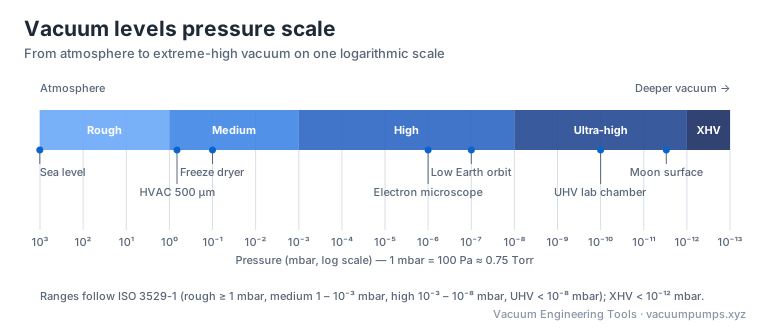
Vacuum ranges at a glance
| Range | Pa | mbar | Torr | Mean free path (air) |
|---|---|---|---|---|
| Low / rough vacuum | 101,300 – 100 | 1,013 – 1 | 760 – 0.75 | 65 nm – 66 µm |
| Medium / fine vacuum | 100 – 0.1 | 1 – 0.001 | 0.75 – 7.5×10⁻⁴ | 66 µm – 66 mm |
| High vacuum (HV) | 0.1 – 1×10⁻⁶ | 0.001 – 1×10⁻⁸ | 7.5×10⁻⁴ – 7.5×10⁻⁹ | 66 mm – 6.6 km |
| Ultra-high vacuum (UHV) | 1×10⁻⁶ – 1×10⁻¹⁰ | 1×10⁻⁸ – 1×10⁻¹² | 7.5×10⁻⁹ – 7.5×10⁻¹³ | 6.6 km – 66,000 km |
| Extreme-high vacuum (XHV) | 1×10⁻¹⁰ – < 10⁻¹⁰ | 1×10⁻¹² – < 10⁻¹² | 7.5×10⁻¹³ – < 10⁻¹² | 66,000 km – > 66 km |
Range boundaries follow ISO 3529-1:2019, the international vacuum vocabulary standard; extreme-high vacuum is a widely used extension below it.
Pumps, gauges and applications by range
Low / rough vacuum
1,013 → 1 mbar
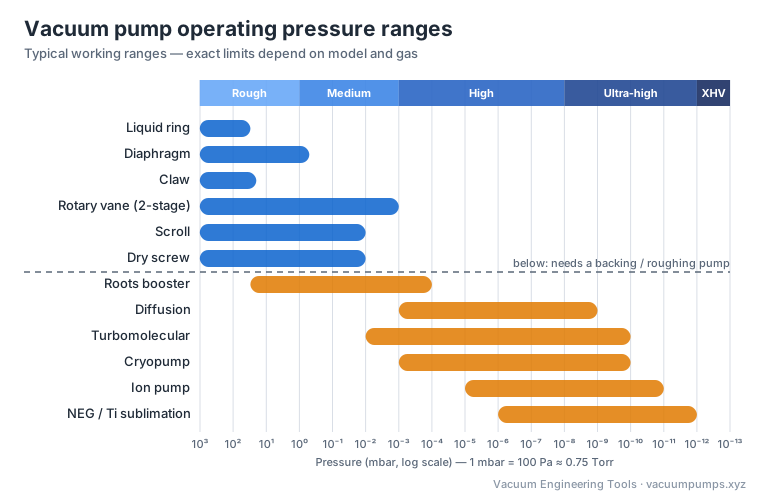
Pumps: Rotary vane, diaphragm, liquid ring, claw, screw, ejectors
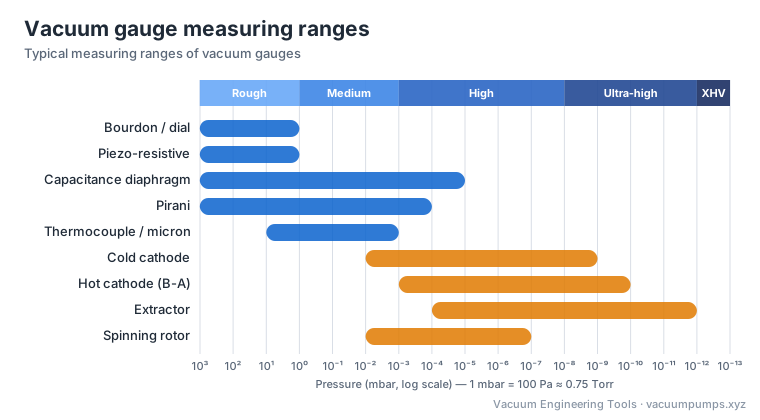
Gauges: Bourdon, piezo, capacitance diaphragm
Applications: Vacuum lifting & handling, packaging, vacuum forming, filtration, degassing, distillation, milking, medical suction
Medium / fine vacuum
1 → 0.001 mbar
Pumps: Two-stage rotary vane, scroll, dry screw, Roots booster
Gauges: Pirani, thermocouple, capacitance diaphragm
Applications: HVAC/R evacuation, freeze drying, vacuum drying, heat treatment, metallurgy, backing of HV pumps
High vacuum (HV)
0.001 → 1×10⁻⁸ mbar
Pumps: Turbomolecular, diffusion, cryopump (with backing pump)
Gauges: Cold cathode (Penning), hot cathode ionization
Applications: Thin-film coating (PVD), electron microscopes, mass spectrometry, vacuum furnaces, CRT & lamp manufacturing
Ultra-high vacuum (UHV)
1×10⁻⁸ → 1×10⁻¹² mbar
Pumps: Turbomolecular, ion getter, titanium sublimation, NEG, cryopump — with bake-out
Gauges: Bayard-Alpert ionization, inverted magnetron, residual gas analyser
Applications: Surface science, particle accelerators, molecular beam epitaxy, semiconductor research
Extreme-high vacuum (XHV)
1×10⁻¹² → < 10⁻¹² mbar
Pumps: Cryogenic systems, NEG + ion pumps, special materials and bake-out
Gauges: Extractor gauges, specialised ionization gauges
Applications: Gravitational-wave detectors, storage rings, fundamental physics experiments
What is the pressure inside a vacuum?
A vacuum is not “zero pressure” — it is simply a pressure lower than the surrounding atmosphere. How low depends entirely on the application. The table below puts familiar examples on the same absolute scale.
| Example | Pa (abs) | Torr | inHg vacuum |
|---|---|---|---|
| Sea level atmosphere | 101,000 | 760 | 0.00 |
| Household vacuum cleaner | 80,000 | 600 | 6.30 |
| Top of Mount Everest (8,849 m) | 33,700 | 253 | 19.97 |
| HVAC evacuation target (500 microns) | 66.7 | 0.5 | 29.90 |
| Freeze dryer | 10 | 0.075 | 29.92 |
| Incandescent light bulb | 1 | 0.0075 | 29.92 |
| Low Earth orbit (≈400 km, ISS) | 1×10⁻⁵ | 7.5×10⁻⁸ | 29.92 |
| Surface of the Moon (night) | 3×10⁻¹⁰ | 2.25×10⁻¹² | 29.92 |
| Interplanetary space | 1×10⁻¹¹ | 7.5×10⁻¹⁴ | 29.92 |
Full vacuum, perfect vacuum and absolute zero pressure
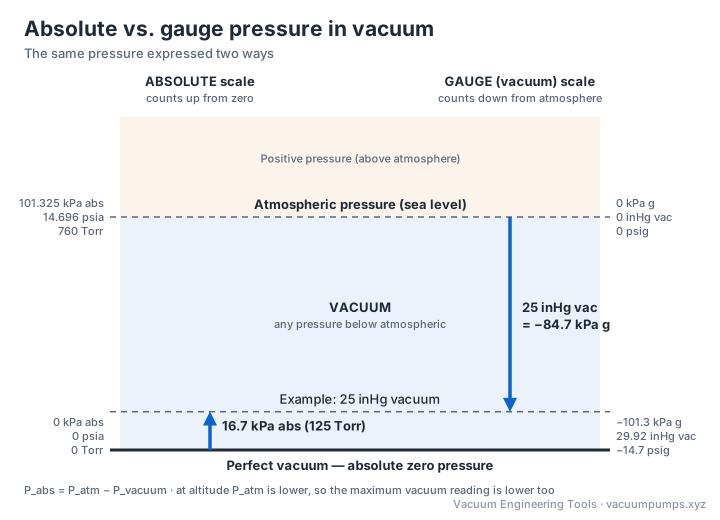
A perfect vacuum — a space with no molecules at all — is a theoretical limit. In gauge units at sea level it corresponds to 29.92 inHg vacuum, −14.696 psig, −101.325 kPa or 100 % vacuum. In absolute units it is simply 0 Pa, 0 Torr or 0 psia. Specifications that say “full vacuum rated” (for tanks and vessels) mean the vessel can withstand the full external atmospheric pressure of ~1 bar without collapsing.
Need to convert between these units? Use the vacuum unit converter.
References & further reading
- ISO/TC 112. ISO 3529-1:2019 Vacuum technology — Vocabulary — Part 1: General terms. International Organization for Standardization (2019). Official definitions of the vacuum ranges.
- PTB Working Group 7.54. Vacuum Metrology. Physikalisch-Technische Bundesanstalt (German national metrology institute). Primary vacuum standards from 10⁻⁹ Pa to 1 kPa and gauge calibration.
- K. Jousten (ed.). Handbook of Vacuum Technology, 2nd ed.. Wiley-VCH (2016). Standard reference on gas flow, conductance, pumps and gauges.
- CERN Accelerator School. CAS Vacuum for Particle Accelerators, Glumslöv, Sweden, 2017 — proceedings. CERN, free to read. Up-to-date lectures on materials, pumps, gauges and leak detection.
Frequently asked questions
What are the levels of vacuum?
Vacuum is divided by absolute pressure into low (rough) vacuum from atmosphere to 100 Pa (1 mbar), medium (fine) vacuum from 100 Pa to 0.1 Pa, high vacuum from 0.1 Pa to 10⁻⁶ Pa, ultra-high vacuum from 10⁻⁶ Pa to 10⁻¹⁰ Pa, and extreme-high vacuum below 10⁻¹⁰ Pa. These follow ISO 3529-1, with XHV as a commonly used extension.
What is the pressure inside a vacuum?
A vacuum is any space with a pressure below atmospheric pressure — it is not zero. A household vacuum cleaner reaches about 80 kPa (20 % vacuum), an HVAC evacuation reaches 500 microns (67 Pa), and an ultra-high vacuum chamber reaches 10⁻⁸ Pa. A perfect vacuum (0 Pa absolute) cannot be achieved in practice.
What is a full vacuum in inches of mercury?
At sea level a perfect vacuum reads 29.92 inHg vacuum, equal to 0 psia, −14.696 psig or −101.325 kPa gauge. At altitude the maximum gauge reading is lower because atmospheric pressure is lower.
What is considered a high vacuum?
High vacuum is the range from 0.1 Pa (10⁻³ mbar, 7.5 × 10⁻⁴ Torr) down to 10⁻⁶ Pa (10⁻⁸ mbar). In this range the mean free path of gas molecules is longer than typical chamber dimensions, so gas flow is molecular and turbomolecular, diffusion or cryopumps are needed.
What is the ultimate vacuum pressure of a pump?
The ultimate (or base) pressure is the lowest pressure a pump can reach when blanked off, with no gas load. Real systems settle above it because of leaks, outgassing and line conductance. Typical values: diaphragm ~1 mbar, two-stage rotary vane ~10⁻³ mbar, turbomolecular 10⁻⁹–10⁻¹⁰ mbar.
Related tools & resources
Vacuum Unit Converter
Convert between inHg, psi, kPa, mbar, Torr, microns and % vacuum — absolute and gauge.
Mean Free Path & Knudsen Number
Mean free path of air, N₂, He, Ar and more, and the flow regime in your pipe.
Vacuum Pump Types
Rotary vane, scroll, screw, Roots, liquid ring, turbo, diffusion, cryo and ion pumps compared.
Vacuum Gauges
Bourdon, capacitance, Pirani, thermocouple and ionization gauges — ranges and accuracy.