Vacuum Unit Converter
Enter a vacuum or pressure value in any unit — absolute or gauge — and see it in every other unit at once, including the vacuum range and the boiling point of water at that pressure.
| Absolute unit | Value |
|---|---|
| Pa | — |
| kPa | — |
| mbar (hPa) | — |
| bar | — |
| Torr | — |
| mmHg | — |
| micron (mTorr) | — |
| psia | — |
| inHg (abs) | — |
| inH₂O (abs, 4 °C) | — |
| atm | — |
| Vacuum / gauge unit | Value |
|---|---|
| inHg vacuum | — |
| psi vacuum (−psig) | — |
| kPa vacuum | — |
| mbar vacuum | — |
| mmHg vacuum | — |
| % vacuum | — |
| Water boils at | — |
Link to this result: copy this URL
How vacuum is measured: absolute vs. gauge
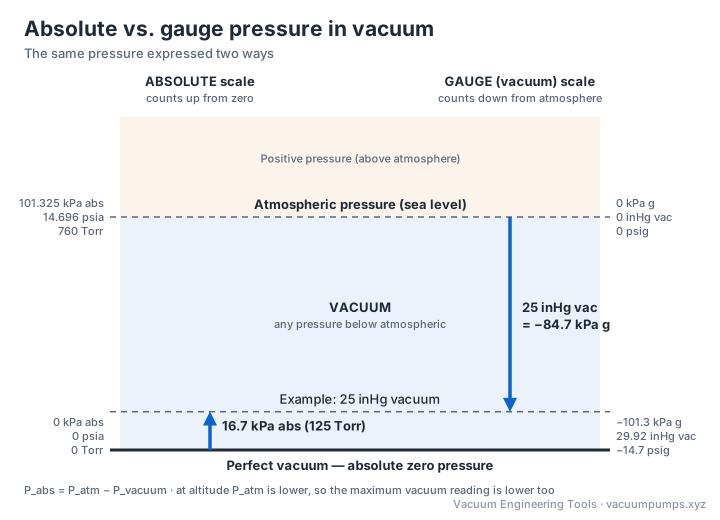
Vacuum is any pressure below the surrounding atmosphere. It is expressed in two ways, and mixing them up is the most common conversion mistake:
- Absolute pressure counts up from a perfect vacuum (zero). Torr, microns, mbar, Pa, psia and kPa abs are absolute. Lower numbers mean deeper vacuum.
- Gauge (vacuum) pressure counts down from local atmospheric pressure. inHg vacuum, −psig, kPa vacuum and % vacuum are gauge readings. Higher numbers mean deeper vacuum, and the maximum depends on the weather and altitude.
Conversion factors
| 1 unit | Pa | Torr | mbar | psi |
|---|---|---|---|---|
| 1 Pa | 1 | 0.00750062 | 0.01 | 1.45038×10⁻⁴ |
| 1 kPa | 1,000 | 7.50062 | 10 | 0.145038 |
| 1 mbar (hPa) | 100 | 0.750062 | 1 | 0.0145038 |
| 1 bar | 100,000 | 750.062 | 1,000 | 14.5038 |
| 1 Torr | 133.322 | 1 | 1.33322 | 0.0193368 |
| 1 mmHg | 133.322 | 1 | 1.33322 | 0.0193368 |
| 1 micron (mTorr) | 0.133322 | 0.001 | 0.00133322 | 1.93368×10⁻⁵ |
| 1 psia | 6,894.76 | 51.7149 | 68.9476 | 1 |
| 1 inHg (abs) | 3,386.39 | 25.4 | 33.8639 | 0.491154 |
| 1 inH₂O (abs, 4 °C) | 249.089 | 1.86832 | 2.49089 | 0.0361273 |
| 1 atm | 101,325 | 760 | 1,013.25 | 14.6959 |
Vacuum conversion chart: inches of mercury
Gauge vacuum in inHg converted to absolute units at standard sea-level pressure (29.92 inHg / 101.325 kPa).
| inHg vacuum | psia | psig | kPa abs | mbar abs | Torr | % vacuum |
|---|---|---|---|---|---|---|
| 0 | 14.696 | 0.00 | 101.33 | 1013.3 | 760.0 | 0.0 |
| 2 | 13.714 | -0.98 | 94.55 | 945.5 | 709.2 | 6.7 |
| 4 | 12.731 | -1.96 | 87.78 | 877.8 | 658.4 | 13.4 |
| 6 | 11.749 | -2.95 | 81.01 | 810.1 | 607.6 | 20.1 |
| 8 | 10.767 | -3.93 | 74.23 | 742.3 | 556.8 | 26.7 |
| 10 | 9.784 | -4.91 | 67.46 | 674.6 | 506.0 | 33.4 |
| 12 | 8.802 | -5.89 | 60.69 | 606.9 | 455.2 | 40.1 |
| 14 | 7.820 | -6.88 | 53.92 | 539.2 | 404.4 | 46.8 |
| 16 | 6.837 | -7.86 | 47.14 | 471.4 | 353.6 | 53.5 |
| 18 | 5.855 | -8.84 | 40.37 | 403.7 | 302.8 | 60.2 |
| 20 | 4.873 | -9.82 | 33.60 | 336.0 | 252.0 | 66.8 |
| 22 | 3.891 | -10.81 | 26.82 | 268.2 | 201.2 | 73.5 |
| 24 | 2.908 | -11.79 | 20.05 | 200.5 | 150.4 | 80.2 |
| 25 | 2.417 | -12.28 | 16.67 | 166.7 | 125.0 | 83.6 |
| 26 | 1.926 | -12.77 | 13.28 | 132.8 | 99.6 | 86.9 |
| 27 | 1.435 | -13.26 | 9.89 | 98.9 | 74.2 | 90.2 |
| 28 | 0.944 | -13.75 | 6.51 | 65.1 | 48.8 | 93.6 |
| 29 | 0.452 | -14.24 | 3.12 | 31.2 | 23.4 | 96.9 |
| 29.5 | 0.207 | -14.49 | 1.43 | 14.3 | 10.7 | 98.6 |
| 29.7 | 0.109 | -14.59 | 0.75 | 7.5 | 5.6 | 99.3 |
| 29.8 | 0.060 | -14.64 | 0.41 | 4.1 | 3.1 | 99.6 |
| 29.9 | 0.010 | -14.69 | 0.07 | 0.7 | 0.5 | 99.9 |
| 29.92 | 0.001 | -14.70 | 0.00 | 0.0 | 0.0 | 100.0 |
Micron vacuum chart
Microns (millitorr) are the standard unit for HVAC/R evacuation and deep vacuum. Below is the equivalent in Torr, Pa, mbar, inHg vacuum, and the temperature at which water boils (or ice sublimes) at that pressure — the reason a 500-micron evacuation removes moisture.
| Microns | Torr | Pa | mbar | inHg vacuum | Water boils at |
|---|---|---|---|---|---|
| 760,000 | 760 | 101,300 | 1,013 | 0.000 | 100.0 °C / 212 °F |
| 100,000 | 100 | 13,330 | 133.3 | 25.984 | 51.5 °C / 125 °F |
| 50,000 | 50 | 6,666 | 66.66 | 27.953 | 38.1 °C / 101 °F |
| 25,000 | 25 | 3,333 | 33.33 | 28.937 | 25.8 °C / 79 °F |
| 10,000 | 10 | 1,333 | 13.33 | 29.528 | 11.2 °C / 52 °F |
| 5,000 | 5 | 666.6 | 6.666 | 29.724 | 1.2 °C / 34 °F |
| 2,500 | 2.5 | 333.3 | 3.333 | 29.823 | -7.2 °C / 19 °F |
| 1,000 | 1 | 133.3 | 1.333 | 29.882 | -17.3 °C / 1 °F |
| 750 | 0.75 | 99.99 | 0.9999 | 29.892 | -20.3 °C / -5 °F |
| 500 | 0.5 | 66.66 | 0.6666 | 29.902 | -24.5 °C / -12 °F |
| 300 | 0.3 | 40 | 0.4 | 29.909 | -29.5 °C / -21 °F |
| 250 | 0.25 | 33.33 | 0.3333 | 29.911 | -31.3 °C / -24 °F |
| 100 | 0.1 | 13.33 | 0.1333 | 29.917 | -39.7 °C / -39 °F |
| 50 | 0.05 | 6.666 | 0.06666 | 29.919 | -45.7 °C / -50 °F |
| 10 | 0.01 | 1.333 | 0.01333 | 29.921 | -58.4 °C / -73 °F |
| 1 | 0.001 | 0.1333 | 0.001333 | 29.921 | -74.4 °C / -102 °F |
References & further reading
- BIPM. The International System of Units (SI Brochure). Bureau International des Poids et Mesures. Definition of the pascal and SI prefixes.
- A. Thompson & B. N. Taylor. NIST Special Publication 811: Guide for the Use of the International System of Units. National Institute of Standards and Technology. Conversion factors for Torr, psi, inHg and other legacy units.
- ISO/TC 112. ISO 3529-1:2019 Vacuum technology — Vocabulary — Part 1: General terms. International Organization for Standardization (2019). Official definitions of the vacuum ranges.
Frequently asked questions
What is the difference between absolute pressure and vacuum (gauge) pressure?
Absolute pressure is measured from a perfect vacuum (zero). Vacuum or gauge readings such as "inHg vacuum" or "−psig" are measured downward from local atmospheric pressure. At sea level, 0 inHg vacuum equals 14.696 psia, and a perfect vacuum reads 29.92 inHg vacuum or 0 psia.
How many microns is a perfect vacuum?
A perfect vacuum is 0 microns absolute. Atmospheric pressure at sea level is 760,000 microns (760 Torr). HVAC evacuation targets such as 500 microns correspond to 0.5 Torr, 66.7 Pa or about 29.90 inHg vacuum.
How do I convert inches of mercury vacuum to psi?
Multiply inHg by 0.49115 to get psi. For vacuum: psia = 14.696 − (inHg vacuum × 0.49115). For example 25 inHg vacuum = 14.696 − 12.28 = 2.42 psia, or −12.28 psig.
How do I convert kPa vacuum to absolute kPa?
Absolute kPa = local atmospheric pressure (101.325 kPa at sea level) − kPa vacuum. So −80 kPa gauge (80 kPa vacuum) is 21.3 kPa absolute.
What does percent vacuum mean?
% vacuum is the share of atmospheric pressure that has been removed: % vacuum = (P_atm − P_abs) / P_atm × 100. 0 % is atmospheric pressure, 100 % is a perfect vacuum. 90 % vacuum at sea level is 10.13 kPa absolute.
Why does altitude change vacuum readings?
Gauge vacuum readings are referenced to local barometric pressure, which falls with altitude. At 1,500 m (≈5,000 ft) the atmosphere is about 84 kPa, so the maximum possible reading is only about 24.9 inHg vacuum instead of 29.92. Absolute units (Torr, microns, psia, kPa abs) are unaffected.
Related tools & resources
Boiling Point Under Vacuum
Boiling temperature of water, ethanol, acetone and more at any vacuum level.
Pump-Down Time Calculator
Evacuation time for a chamber — or the pump size you need for a target time.
Vacuum Levels & Ranges
Rough, medium, high and ultra-high vacuum explained with pressure ranges and applications.
Vacuum Gauges
Bourdon, capacitance, Pirani, thermocouple and ionization gauges — ranges and accuracy.