Pressure Units Explained
Pascal, bar, psi, Torr and the rest all measure the same thing: force per area. This page lists every common pressure unit with its exact value in pascals, where it is used and how to convert it, plus a converter that shows any value in all units at once.
| Unit | Value |
|---|---|
| Pascal (Pa) | 100,000 |
| Hectopascal (hPa) | 1,000 |
| Kilopascal (kPa) | 100 |
| Megapascal (MPa) | 0.1 |
| Millibar (mbar) | 1,000 |
| Bar (bar) | 1 |
| Standard atmosphere (atm) | 0.986923 |
| Torr | 750.062 |
| Millimetre of mercury (mmHg) | 750.062 |
| Micron of mercury (mTorr) | 750,062 |
| Pound-force per square inch (psi) | 14.5038 |
| Inch of mercury (inHg) | 29.53 |
Absolute pressure. For gauge vacuum readings use the vacuum converter.
The pressure units at a glance
| Unit | Symbol | Value in Pa | Definition | Typical use |
|---|---|---|---|---|
| Pascal | Pa | 1 | SI unit of pressure: one newton per square metre (1 N/m²). | Science, standards, vacuum calculations, simulations. |
| Hectopascal | hPa | 100 | 100 Pa. Numerically identical to the millibar. | Weather reports and aviation (barometric pressure). |
| Kilopascal | kPa | 1,000 | 1,000 Pa; 100 kPa = 1 bar. | Engineering data sheets, tyre pressure in some countries, HVAC. |
| Megapascal | MPa | 1×10⁶ | 1,000,000 Pa = 10 bar. | Hydraulics, pressure vessels, material strength. |
| Millibar | mbar | 100 | 1/1,000 bar = 100 Pa = 1 hPa. | European vacuum technology, barometers, gas supply. |
| Bar | bar | 100,000 | Exactly 100,000 Pa. Close to, but not equal to, one atmosphere. | Industry, compressed air, hydraulics, tyres (Europe). |
| Standard atmosphere | atm | 101,325 | Defined as exactly 101,325 Pa, the mean sea-level air pressure. | Chemistry, physics, reference conditions. |
| Torr | Torr | 133.3223684 | 1/760 of a standard atmosphere = 133.322368 Pa. | Vacuum gauges, deposition and semiconductor tools, US vacuum literature. |
| Millimetre of mercury | mmHg | 133.3223874 | 133.322387415 Pa (conventional). Within 0.000015 % of the Torr. | Blood pressure, older vacuum and lab equipment. |
| Micron of mercury (mTorr) | micron | 0.1333223684 | 1/1,000 Torr = 0.133322 Pa. | HVAC/R evacuation (500 microns target), vacuum process control. |
| Pound-force per square inch | psi | 6,894.757293 | 6,894.757293168 Pa. psia = absolute, psig = above atmosphere. | US industry, tyres, compressors, hydraulics. |
| Inch of mercury | inHg | 3,386.389 | 3,386.389 Pa (conventional, 0 °C). 29.92 inHg = 1 atm. | US barometers, HVAC manifolds and vacuum gauges (inHg vacuum). |
Absolute, gauge and vacuum pressure
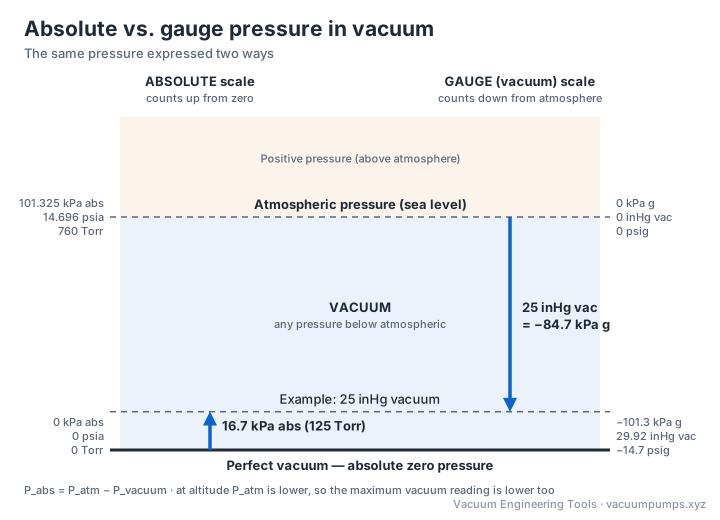
Every unit above can be used in two ways. Absolute pressure is counted up from a perfect vacuum, so it can never be negative. Gauge pressure is counted from the surrounding atmosphere: a tyre at 2.2 bar gauge is at about 3.2 bar absolute. Vacuum gauges in inHg vacuum, kPa vacuum or % vacuum count downward from atmosphere, so their maximum depends on weather and altitude.
The conversion factors on this page are the same for absolute and gauge values. Converting between the two needs the local atmospheric pressure, which the vacuum unit converter handles, including an altitude correction.
Torr vs. mmHg
The Torr is defined as exactly 1/760 of a standard atmosphere (133.322368 Pa); the conventional millimetre of mercury is 133.322387415 Pa. They differ by less than 0.000015 %, far below the accuracy of any gauge, so vacuum practice treats them as the same. The micron used in HVAC is one thousandth of a Torr.
Conversion factors between all pressure units
Download the printable conversion chart (PDF, A4) Two pages: full factor table, unit definitions, bar ↔ psi and mbar ↔ Torr tables. Free to print and share.
Read across: 1 unit in the left column equals the value shown in each column unit.
| 1 ↓ = | Pa | hPa | kPa | MPa | mbar | bar | atm | Torr | mmHg | micron | psi | inHg |
|---|---|---|---|---|---|---|---|---|---|---|---|---|
| Pa | 1 | 0.01 | 0.001 | 1×10⁻⁶ | 0.01 | 1×10⁻⁵ | 9.86923×10⁻⁶ | 0.00750062 | 0.00750062 | 7.50062 | 1.45038×10⁻⁴ | 2.953×10⁻⁴ |
| hPa | 100 | 1 | 0.1 | 1×10⁻⁴ | 1 | 0.001 | 9.86923×10⁻⁴ | 0.750062 | 0.750062 | 750.062 | 0.0145038 | 0.02953 |
| kPa | 1,000 | 10 | 1 | 0.001 | 10 | 0.01 | 0.00986923 | 7.50062 | 7.50062 | 7,500.62 | 0.145038 | 0.2953 |
| MPa | 1×10⁶ | 10,000 | 1,000 | 1 | 10,000 | 10 | 9.86923 | 7,500.62 | 7,500.62 | 7.50062×10⁶ | 145.038 | 295.3 |
| mbar | 100 | 1 | 0.1 | 1×10⁻⁴ | 1 | 0.001 | 9.86923×10⁻⁴ | 0.750062 | 0.750062 | 750.062 | 0.0145038 | 0.02953 |
| bar | 100,000 | 1,000 | 100 | 0.1 | 1,000 | 1 | 0.986923 | 750.062 | 750.062 | 750,062 | 14.5038 | 29.53 |
| atm | 101,325 | 1,013.25 | 101.325 | 0.101325 | 1,013.25 | 1.01325 | 1 | 760 | 760 | 760,000 | 14.6959 | 29.9213 |
| Torr | 133.322 | 1.33322 | 0.133322 | 1.33322×10⁻⁴ | 1.33322 | 0.00133322 | 0.00131579 | 1 | 1 | 1,000 | 0.0193368 | 0.0393701 |
| mmHg | 133.322 | 1.33322 | 0.133322 | 1.33322×10⁻⁴ | 1.33322 | 0.00133322 | 0.00131579 | 1 | 1 | 1,000 | 0.0193368 | 0.0393701 |
| micron | 0.133322 | 0.00133322 | 1.33322×10⁻⁴ | 1.33322×10⁻⁷ | 0.00133322 | 1.33322×10⁻⁶ | 1.31579×10⁻⁶ | 0.001 | 1×10⁻³ | 1 | 1.93368×10⁻⁵ | 3.93701×10⁻⁵ |
| psi | 6,894.76 | 68.9476 | 6.89476 | 0.00689476 | 68.9476 | 0.0689476 | 0.068046 | 51.7149 | 51.7149 | 51,714.9 | 1 | 2.03602 |
| inHg | 3,386.39 | 33.8639 | 3.38639 | 0.00338639 | 33.8639 | 0.0338639 | 0.0334211 | 25.4 | 25.4 | 25,400 | 0.491154 | 1 |
Converters for common pairs
Bar to PSI Converter
1 bar = 14.504 psi
PSI to Bar Converter
1 psi = 0.068948 bar
Inches of Mercury to PSI Converter
1 inHg = 0.49115 psi
Bar to Pascal Converter
1 bar = 100,000 Pa
Pascal to Bar Converter
1 bar = 100,000 Pa
Torr to Pascal Converter
1 Torr = 133.32 Pa
mbar to Torr Converter
1 mbar = 0.75006 Torr
inHg to kPa Converter
1 inHg = 3.3864 kPa
Torr to mbar Converter
1 Torr = 1.3332 mbar
Microns to Torr Converter
1 Torr = 1,000 microns
References & further reading
- BIPM. The International System of Units (SI Brochure). Bureau International des Poids et Mesures. Definition of the pascal and SI prefixes.
- A. Thompson & B. N. Taylor. NIST Special Publication 811: Guide for the Use of the International System of Units. National Institute of Standards and Technology. Conversion factors for Torr, psi, inHg and other legacy units.
- ISO/TC 112. ISO 3529-1:2019 Vacuum technology — Vocabulary — Part 1: General terms. International Organization for Standardization (2019). Official definitions of the vacuum ranges.
Frequently asked questions
What is the SI unit of pressure?
The pascal (Pa), equal to one newton per square metre. Because it is small, kPa, MPa and hPa are common; the bar (100,000 Pa) and millibar (100 Pa) are metric units accepted alongside the SI.
What is the difference between bar and atm?
1 bar is exactly 100,000 Pa. 1 standard atmosphere (atm) is exactly 101,325 Pa, the mean sea-level air pressure. So 1 atm = 1.01325 bar, and the two differ by about 1.3 %.
Which pressure unit is used for vacuum?
It depends on the region and field: mbar in Europe, Torr in the US and in semiconductor tools, Pa in standards and science, and microns (millitorr) in HVAC/R. All of them are absolute units, counted up from a perfect vacuum.
Is psi absolute or gauge pressure?
Either: psia is absolute (from a perfect vacuum) and psig is gauge (above atmospheric pressure). Plain "psi" on tyres and compressors usually means psig; at sea level psia = psig + 14.696.
Related tools & resources
Vacuum Unit Converter
Convert between inHg, psi, kPa, mbar, Torr, microns and % vacuum — absolute and gauge.
Leak Rate & Gas Flow Converter
mbar·L/s, Pa·m³/s, Torr·L/s, atm·cc/s, sccm and slm — plus leak-tightness classes.
Vacuum Levels & Ranges
Rough, medium, high and ultra-high vacuum explained with pressure ranges and applications.
Vacuum Gauges
Bourdon, capacitance, Pirani, thermocouple and ionization gauges — ranges and accuracy.